Last time we followed quantum research out into the world. This time we played the same game with engineering biology, the business of reading and writing DNA and the proteins it makes. We found 63 research communities and about 41,000 papers from 2022 to 2024, then followed the citations out of them, reading the papers on both sides of every step.
You would guess the work flows to medicine, and some of it does. But the strongest pulls we found came from people who do not think of themselves as biologists. Engineers who want to store data in DNA are pushing hardest on how to write it. Materials scientists borrow protein models to study how things bend and break. Agricultural quarantine programs carry insect methods that began in disease research.
And the customer everybody expects, the factory that makes antibody drugs, barely reads the gene-editing literature at all. In engineering biology the customers are strangers, and that changes who should be paying attention to what.
Bottom line
Engineering biology’s most consequential demand now comes from outside biology. Data-storage research is one of two big pulls on enzymatic DNA writing, alongside drug manufacturing. Insect-control methods travel into agricultural trade programs funded by a UN nuclear agency. Biopharmaceutical manufacturing, the obvious customer, takes almost nothing from gene editing and runs on pre-CRISPR methods.
The US and China picture differs from quantum. Western researchers under-read Chinese work here too, most of all in industrial fermentation, which the US has largely left to others. But co-authorship is rising rather than falling, and in CRISPR diagnostics, which China dominates, nearly a third of US papers now carry a Chinese co-author.
Public version
Two threads here touch work that cuts both ways. Everything above is open literature and we publish it in full, because an argument you cannot check is worth nothing. What a client pays for is the judgment we build on top of it, starting with the step we think gates each capability and what would move it. The four questions at the end of this briefing are the ones we answer in that work.
Thread 1
From a DNA computer to a DNA printer
Community 1
DNA computing circuits
- Papers, 2024
- 171
- Since 2021
- +1%
- Lead
- China 50%
circuits that search and compute on data while it sits in DNA
2.3% in 2025
since 2015, 3% line dashed28 of 143 institutions write half the papers that draw on this link. Largest: Guangzhou University, 6%.
Parallel molecular computation on digital data stored in DNA (2023), read by Data Storage Using DNA (2023).
Community 2
DNA data storage
- Papers, 2024
- 288
- Since 2021
- +24%
- Lead
- China 31%
a demand for DNA writing that’s cheap, fast and done in water
9.4% in 2025
since 2015, 3% line dashed11 of 57 institutions write half the papers that draw on this link. Largest: Institut Pasteur, 10%.
Terminator-free template-independent enzymatic DNA synthesis for digital information storage (2019), read by Enzymatic DNA Synthesis by Engineering Terminal Deoxynucleotidyl Transferase (2022).
Community 3
Enzymatic DNA synthesis
- Papers, 2024
- 33
- Since 2021
- +175%
- Lead
- Europe 36%, China 36%
Here is a problem you might not expect. Reading DNA got about a million times cheaper in twenty years. Writing it did not. The standard chemistry builds a strand one letter at a time using harsh solvents, and it runs out of accuracy after a couple of hundred letters. For most of biology that is fine. For anyone who wants to keep a film archive in DNA, it is hopeless.
So the storage people went looking for a better pen, and found one in an enzyme our immune cells use to add DNA letters in water without a template. The small community that engineers that enzyme now draws 9.5% of its outside citations from data storage, up from 2.5% in 2019, and half the papers citing storage are about storage itself. An equal second pull comes from drug makers who need short strands for medicines and hit the same length limits. Upstream, DNA computing hands the storage people circuits that search an archive without reading it out first.
Who is doing it? China writes 31% of the storage papers and Microsoft puts a fifth of its engineering-biology output there. The enzyme work splits evenly between Europe and China at 36% each, with Institut Pasteur, CNRS and Roche among the busiest bridges, and the US at 15%.
So what. Screening orders for synthetic DNA works today partly because a few large suppliers make most of it. Cheaper enzymatic writing, funded in part by the storage business, points toward that capability spreading to more benches. Anyone setting synthesis-screening policy should treat storage-driven enzyme work as part of the same trend and bring those funders into the conversation early.
See this thread on the mapThread 2
From gene editing to an export inspection
Community 1
CRISPR genome editing
- Papers, 2024
- 1,968
- Since 2021
- +2%
- Lead
- China 24%, US 23%
the editing tools, plus simple ways to edit insects nobody had edited before
8.2% in 2025
since 2015, 3% line dashed46 of 401 institutions write half the papers that draw on this link. Largest: Imperial College London, 5%.
Genome Engineering of Drosophila with the CRISPR RNA-Guided Cas9 Nuclease (2013), read by SYNCAS: Efficient CRISPR/Cas9 gene-editing in difficult to transform arthropods (2024).
Community 2
Insect gene drives
- Papers, 2024
- 206
- Since 2021
- −21%
- Lead
- US 35%
ways to breed and release only males
5.1% in 2025
since 2015, 3% line dashed31 of 194 institutions write half the papers that draw on this link. Largest: International Atomic Energy Agency, 8%.
Sex Sorting for Pest Control: It’s Raining Men! (2019), read by Combining two genetic sexing strains allows sorting of non-transgenic males for Aedes genetic control (2023).
Community 3
Sterile insect technique
- Papers, 2024
- 92
- Since 2021
- −5%
- Lead
- Europe 30%
rearing, sterilizing and releasing flies by the million
5.6% in 2025
since 2015, 3% line dashed48 of 305 institutions write half the papers that draw on this link. Largest: NSW Department of Primary Industries, 3%.
Possibilities of Insect Control or Eradication Through the Use of Sexually Sterile Males (1955), read by Important alien and potential native invasive insect pests of key fruit trees in Sub-Saharan Africa: advances in sustainable pre- and post-harvest management approaches (2022).
Community 4
Invasive fruit flies
- Papers, 2024
- 248
- Since 2021
- +6%
- Lead
- No bloc above 11%
This thread starts where you would expect, in the gene-editing literature, and ends somewhere you would not, in the paperwork that lets a crate of mangoes cross a border. The middle step is the sterile insect technique, an idea from the 1950s. Rear a great many insects, sterilize the males with radiation, release them, and the wild population falls because many matings produce nothing. It is old, unglamorous and still the mainstay against agricultural pests.
We expected the gene-drive community to hand that older field its population models. Reading the papers says otherwise. What crosses is the practical business of producing and releasing males only, which both communities need and which the newer work has pushed forward. The top cited papers on that link are a Guatemalan program that sorts male fruit flies at scale, a field trial in Brazil, and a review with the title “Sex Sorting for Pest Control: It’s Raining Men!”
Then follow the money and the institutions. Upstream, the funders are health agencies and foundations, and the leading labs are Imperial College London and UC San Diego, which is what you would expect of disease research. Downstream, the largest single bridge is the International Atomic Energy Agency, which appears on 8% of the papers carrying that link, and further along the leaders are agricultural departments in Australia and research centers in Mexico, Egypt and China. The gene-drive community is shrinking, down 21% since 2021, while the agricultural work carries on.
So what. The institutional capacity for releasing engineered or sterilized insects into the environment sits in agriculture and quarantine bodies and in a UN nuclear-technology agency, well away from the biosecurity institutions that watch the upstream science. Anyone writing governance for environmental release should be talking to those agricultural bodies, because that is where the practical expertise and the field programs already live. We can name the technical step that gates a release program, which is breeding and sorting at scale. Whether permission binds before it is not something citation data can settle, and we would rather say so than rank the two.
See this thread on the mapThread 3
From protein folding to a materials model
Community 1
ML protein structure and design
- Papers, 2024
- 1,393
- Since 2021
- +83%
- Lead
- US 33%, Europe 31%
protein data and the modeling recipe, applied to how materials bend and break
2.0% in 2025
since 2015, 3% line dashed1 of 11 institutions write half the papers that draw on this link. Largest: MIT, 76%.
Highly accurate protein structure prediction with AlphaFold (2021), read by ProtAgents: protein discovery via large language model multi-agent collaborations combining physics and machine learning (2024).
Community 2
Generative models for materials
- Papers, 2024
- 66
- Since 2021
- +288%
- Lead
- US 64%
AlphaFold and the tools after it made protein structure prediction work, and the fastest-growing community reading that work is not in biology at all. It builds language models for materials design, and it grew 288% in three years.
We first read this as the quantum pattern repeating, with the method traveling and the science staying home. The papers corrected us. The receiving work is about the mechanics of proteins, how silk and bone and collagen carry load, so the protein science does travel. What stays behind is biological function, the business of what a protein does in a cell.
Then the bridge count stopped us. One institution, MIT, writes 76% of the papers on this link, and the citing work comes from a single research group. This is not a field adopting a method. It is one laboratory, which happens to be prolific.
So what. Treat a fast-rising link as one lab until you check. Measured on share alone this looks like a new interdisciplinary pathway worth funding. Measured on who writes it, the right question is narrower, whether anyone besides one group can use protein models for materials, and that is a question about benchmarks and training data rather than about more papers.
See this thread on the mapThread 4
The thread that breaks
Community 1
CRISPR genome editing
- Papers, 2024
- 1,968
- Since 2021
- +2%
- Lead
- China 24%, US 23%
where to put a new gene so it stays switched on and harms nothing
26.1% in 2025
since 2015, 3% line dashed10 of 52 institutions write half the papers that draw on this link. Largest: Institut Cellule Souche et Cerveau and Ferdowsi University of Mashhad, 11% each.
Safe harbours for the integration of new DNA in the human genome (2011), read by Discovery and validation of human genomic safe harbor sites for gene and cell therapies (2022).
Community 2
Where to place a new gene
- Papers, 2024
- 27
- Since 2021
- +286%
- Lead
- Europe 39%, US 30%
almost nothing, a tenth of a percent of citations, mostly to pre-CRISPR expression lore
0.1% in 2025
since 2015, 3% line dashed9 of 36 institutions write half the papers that draw on this link. Largest: Ajou University, 12%.
Repeat-induced gene silencing in mammals (1998), read by Progress of Transposon Vector System for Production of Recombinant Therapeutic Proteins in Mammalian Cells (2022).
Community 3
Cells that make antibody drugs
- Papers, 2024
- 327
- Since 2021
- +10%
- Lead
- Europe 34%
process control, models that steer a bioreactor in real time
5.5% in 2025
since 2015, 3% line dashed33 of 205 institutions write half the papers that draw on this link. Largest: IIT Delhi, 3%.
Quality by control: Towards model predictive control of mammalian cell culture bioprocesses (2017), read by Modern Sensor Tools and Techniques for Monitoring, Controlling, and Improving Cell Culture Processes (2022).
Community 4
Watching a bioreactor with light
- Papers, 2024
- 117
- Since 2021
- +18%
- Lead
- Europe 52%
We went looking for the obvious one. Gene editing should flow into the cells that manufacture antibody drugs, an industry that depends on putting a gene into a hamster cell line and keeping it switched on.
The first step is the strongest link in this whole briefing. A tiny community, 27 papers a year, works out where in the human genome you can place a new gene so it stays active and disturbs nothing. It draws 28% of its outside citations from CRISPR research. Almost no industry money is in it, and Europe and the US write 39% and 30% of it, with China at 2%.
Then the thread breaks. The manufacturing community takes 0.1% of its citations from that work, 26 references out of twenty thousand, and the few that exist point at expression lore from the 1990s. The manufacturers are still using methods that predate CRISPR, and the last step, where sensors watch a bioreactor in real time, turns out to carry process control rather than anything genetic.
So what. A chain that fails is worth as much as one that holds. Nobody should assume that editing advances reach the medicine factory on their own, because today they do not. The bottleneck is regulatory and practical, a short list of insertion sites validated in approved production lines, and that is the thing to fund if you want the transfer to happen.
See this thread on the mapInstitutions
What the big players publish
Then we read what the largest producers actually publish. Several are not the institutions a Western reader would name.
Chinese Academy of Sciences
Broad and editing-heavy, from wheat disease resistance to rapid virus detection.
- Gene editing16%
- CRISPR diagnostics10%
- Yeast cell factories6%
- mRNA delivery5%
- Everything else64%
Jiangnan University
The surprise of the set. A food-science university is China’s third-largest producer in the field, publishing on sweeteners, amino acids and rare sugars.
- Yeast cell factories15%
- Amino-acid production11%
- Microbial flavonoids10%
- Rare sugars7%
- Everything else57%
University of Washington
The center of computational protein design, and the source of several tools the rest of the field runs on.
- ML protein design28%
- Designed protein cages12%
- Genome-scale models9%
- Gene-therapy vectors8%
- Everything else44%
Broad Institute
Editing first, with delivery close behind, including a vector engineered to carry genes across the blood-brain barrier.
- Gene editing38%
- ML protein design11%
- Gene-therapy vectors9%
- CRISPR diagnostics9%
- Everything else33%
BGI Group
Known as a sequencing company, it publishes here as a genome-writing one. A third of its papers are on building synthetic yeast chromosomes.
- Synthetic chromosomes36%
- Gene editing21%
- DNA data storage19%
- Genetic code expansion8%
- Everything else17%
Google DeepMind
Every one of its 22 papers in the field sits in a single community. No other actor is this concentrated.
- ML protein design100%
Microsoft puts 22% of its engineering-biology papers into DNA data storage, so it is here about as much for DNA as a storage medium as for biology.
Research security
Everyone reads their own
We traced every citation between engineering-biology papers published from 2022 to 2024. American authors cite Chinese work at 0.48 times its weight and European authors at 0.51, while they read each other at about 0.9. Chinese authors return some of it, citing US work at 0.74 and European work at 0.61. The gap is real but milder than quantum, where the same measure ran at 0.42.
The worst of it is in industrial fermentation, the largest part of the field. Europe cites Chinese work there at 0.46, China cites European work at 0.52, and the two biggest producers largely ignore each other. The US is not really in that argument, holding 11% of a subfield where Europe has 31% and China 29%, and where Chinese output runs ahead of American by two and a half to one.
Co-authorship moves the other way from quantum. US papers with a Chinese co-author rose from 10.2% in 2022 to 13.0% in 2025. In CRISPR diagnostics, which is 62% Chinese, 32% of US papers carried a Chinese co-author in 2025, against 5% the other way. In the part of the field China dominates, the American side is the junior partner.
- US
- Europe
DNA storage and computing
0.40×0.48×Industrial fermentation
0.55×0.46×Gene editing
0.58×0.69×CRISPR diagnostics
0.64×0.76×All engineering biology
0.48×0.51×
1.0 means cited in proportion to China’s share of the recent papers being cited. Citations between papers published 2022 to 2024. The dashed line marks parity.
Implications
Second-order effects
- 01
Synthesis screening has a second constituency
Data-storage research is one of the two strongest pulls on cheap enzymatic DNA writing. Screening policy written only with biology funders in the room will miss who is paying.
- 02
The US has left the largest part of the field
Industrial fermentation is a quarter of engineering biology. The US holds 11% of it, growth is flat, and the leading Chinese producer is a food-science university.
- 03
Environmental-release expertise sits in agriculture
The institutions that actually rear and release insects are agricultural and quarantine agencies, together with a UN nuclear-technology body.
- 04
Editing does not reach the medicine factory
Antibody manufacturing draws 0.1% of its citations from research on gene placement. The transfer everyone assumes is not happening.
- 05
A materials community is largely a defense program
US military funders are on 21% of the papers in the community that carries protein design into materials, seventeen times their share of protein design itself.
- 06
A US lead rests on a few tools
Protein design is the clearest American advantage and the most concentrated area in the field, where ten papers take 17% of the citations and one corporate lab writes in nothing else.
- 07
Rapid field detection is concentrated in one country
CRISPR diagnostics is 62% Chinese, the fastest-growing part of the field, with the lowest industry share, and Chinese papers skew to detection you can carry.
The money
Who pays and who collects
Then we followed the money through each thread, from the grants that fund the upstream science to the organizations publishing at the applied end. The pattern is not the same twice.
| Thread | Who pays upstream | Who builds the applied end | What that means |
|---|---|---|---|
| DNA writing | China’s national science foundation on a third of the DNA-computing papers and a fifth of the storage papers, with its national R&D program and the US science foundation behind. | The enzyme community is funded one grant at a time from France, Britain, the US and Russia. Roche is the only company publishing more than twice. | Nobody who would sell DNA storage is paying for the writing step it needs. Microsoft and Seagate publish on storage and are absent from the enzyme work, where a drug company holds the ground. |
| Protein design | US health money, which covers about 16% of protein-design papers, with the science foundation behind it. Defense is small here but present, DARPA on 17 papers and the Defense Threat Reduction Agency on 13. The corporate presence is software. | US military funders are on 21% of the materials-model papers, led by the Army Research Office with 28 and the Office of Naval Research with 25, then agriculture and health. | Health money builds the toolkit and the armed services pay to carry it into materials, at roughly seventeen times their share of protein design itself. It is a defense-funded community wearing a materials label, and no company has captured it. |
| Insect control | US health agencies on 18% of gene-drive papers, philanthropy on 12% (Gates 51, Open Philanthropy 25, Wellcome 20), and defense on 5%, nearly all of it DARPA with 31. Western grant money, aimed at disease. | The International Atomic Energy Agency on 13% of the sterile-insect papers, then the EU, US agriculture, China’s national program and Norwegian aid. One company appears. | Western health, philanthropic and defense grants build it, and agricultural and nuclear agencies operate it. Philanthropy outspends defense by about two and a half to one. |
| Antibody factory | China’s science foundation and the US health institutes at very large scale on CRISPR itself. The gene-placement community has no funder on more than three papers. | Industry. A quarter of the institutions publishing on manufacturing cells and on bioreactor sensing are companies: Boehringer, Merck, WuXi, Sartorius, Pfizer, Amgen. | The firms that own biologics manufacturing fund the step that works and do not need the academic chain, which is why the chain breaks. US industrial-policy money is almost absent. |
Funders are counted from acknowledgements, which cover 18% to 62% of papers depending on the community, so every share is a floor and shares cannot be added together. Defense counts the US military research offices and agencies together, so a paper thanking two of them counts once. Company counts come from institution records, which OpenAlex sometimes mislabels; the ones we excluded are listed in the records.
Forecast
The next threads
Then we ran the game forward, looking for links out of engineering biology that are still weak but rising fastest, reading the papers on both sides and throwing out the ones that only share a word. Two survived, and together they say something the four threads above only hint at. What leaves this field is mostly a way of detecting or measuring something, not a way of making it.
CRISPR becomes a way to check your food
- 2019–210.6%
- 2022–241.8%
- 2023–252.4%
The fastest-growing community in engineering biology is not editing anything. It uses CRISPR enzymes as a detector: when the enzyme finds the sequence it was looking for, it starts cutting everything nearby, which lights up a readout you can see on a paper strip. That community has grown from 525 papers in 2021 to 1,103 in 2025.
The community it now feeds is food-safety testing, and the link has risen every single year, from 0.3% of outside citations in 2019 to 3.1% in 2025. Two smaller branches go to meat authentication, which matters for halal certification, and to detecting gene-edited crops, where it has already passed 3%. The receiving papers are operational, about identifying a meat species in minutes or finding a pathogen in a food sample.
The geography is lopsided. China writes 62% of the papers making the crossing into food-pathogen testing against 6% for the US, and 57% of the crossing into both meat authentication and crop detection. China’s agriculture ministry appears on all three. Companies are essentially absent, so this is public money building a capability rather than a market forming.
So what. A country that can check a food sample for a pathogen, a species or a genetic edit, cheaply and in the field, holds a trade instrument as much as a public-health one. The same capability sits under halal certification in Indonesia and Malaysia, and under Europe’s rules on gene-edited crops, which depend on being able to detect an edit at all. Buyers and regulators should ask who supplies the assay they rely on.
CRISPR-Cas12a target binding unleashes indiscriminate single-stranded DNase activity (2018), read by Research progress on detection of foodborne pathogens: the more rapid and accurate answer to food safety (2024).
See it on the mapThe gene-editing bottleneck turns out to be a measurement problem
- 2019–210.3%
- 2022–242.0%
- 2023–252.5%
A gene-editing medicine is a guide molecule that steers the enzyme to one place in the genome. Before anyone can use a batch of it, somebody has to prove what is actually in the vial, which sequence, which chemical modifications, which impurities. That is analytical chemistry, not biology.
The community that does it, which built its methods for an older class of nucleic-acid drugs, now draws 2.5% of its outside citations from CRISPR research, up from 0.3% before 2022. Every paper making the crossing is about measuring a guide molecule. It is the most industrial community in anything we screened, with instrument makers and drug companies publishing in it.
The crossing is 60% American and 27% European, and no Chinese institution appears on it at all. Only three of the 29 crossing papers name a funder, which tells you who is paying: vendors and drug companies, not grant agencies.
So what. The release gate for gene-editing medicines is an analytical method, and it is being built inside companies. That is the same shape as the antibody-factory thread, where the knowledge that matters sits as commercial practice rather than in the literature. Anyone forecasting how fast these therapies reach patients should watch the measurement methods, not the editing papers.
Chemically modified guide RNAs enhance CRISPR-Cas genome editing in human primary cells (2015), read by Top-Down Mass Spectrometry of Synthetic Single Guide Ribonucleic Acids Enabled by Facile Sample Clean-Up (2023).
See it on the mapWithheld
What the full version answers
These four are judgments rather than findings, so they are not on this page. Each one goes to a client with the evidence underneath it, and with what we could not establish stated as plainly as what we could.
- 01
The gating step in each thread
Which single step decides whether each of these four chains reaches its application, and what would have to change for it to stop being the bottleneck.
- 02
Everyone carrying each link
The full roster of organizations that carry each of the twelve links, by name, share and funder, rather than the counts and the single largest that appear here.
- 03
Single-group exposure
The points in these chains where one organization or one laboratory does most of the work, named, with the papers that establish it and what happens if that group stops.
- 04
Early-warning indicators
The specific numbers we would recompute each quarter to tell whether each prediction is turning, and the thresholds that would count as a turn.
On the record
What we expect by October 2027
A forecast you cannot check is not worth much. Here is what we expect, and in October 2027 we will rerun the numbers on the new map and publish the score.
- 01
Data storage keeps pulling DNA writing forward.
True if enzymatic DNA synthesis draws at least 8% of its outside citations from data storage in 2026.
Now: 9.5% in 2024 and 9.4% in 2025, up from 2.5% in 2019.
- 02
Gene editing still will not reach antibody manufacturing.
True if the link from gene-placement research into manufacturing cell lines stays under 1%.
Now: 0.1%, and never above 0.2% in any year since 2015.
- 03
The protein-design link to materials stays one laboratory.
True if MIT still writes more than half the papers carrying it.
Now: 76% of the bridge weight, and one institution reaches half.
- 04
Western readers will not close the gap on Chinese fermentation work.
True if US and European citation of it stays at 0.60 of its weight or below for 2023 to 2025.
Now: 0.55 and 0.46 for 2022 to 2024.
- 05
CRISPR detection becomes a full thread into food testing.
True if the link passes 3% for 2024 to 2026.
Now: 2.4% for 2023 to 2025, and 3.1% in 2025 alone.
- 06
US dependence on Chinese co-authors keeps rising.
True if at least 13% of US field papers carry a Chinese affiliation in 2026.
Now: 13.0% in 2025, up from 10.2% in 2022.
How we did this
Threads follow links where the receiving community draws at least 3% of its citations to other communities from the giving one, from 2022 to 2024 on the 2026 Syntheos Map of Science. At each link we read the most-cited papers on the giving side that the receiving side uses, and a sample of the receiving papers, from their titles and abstracts. The pair of papers shown on each link is a citation we checked in the data, not an illustration. Thread 4 is included because its middle link fails that test. Country shares split each paper evenly across its authors’ countries, and bridge counts split each receiving paper evenly across its institutions. Affiliation data starts in 2022, so country shares do not run earlier. We also measured movement of researchers between countries and found the author records too unreliable to report. Data from OpenAlex.
Sources
- Deng et al., Discovery and validation of human genomic safe harbor sites for gene and cell therapies, Cell Reports Methods, 2022
- Lee et al., Terminator-free template-independent enzymatic DNA synthesis for digital information storage, Nature Communications, 2019
- Lutrat et al., Sex Sorting for Pest Control: It’s Raining Men!, Trends in Parasitology, 2019
- Jumper et al., Highly accurate protein structure prediction with AlphaFold, Nature, 2021
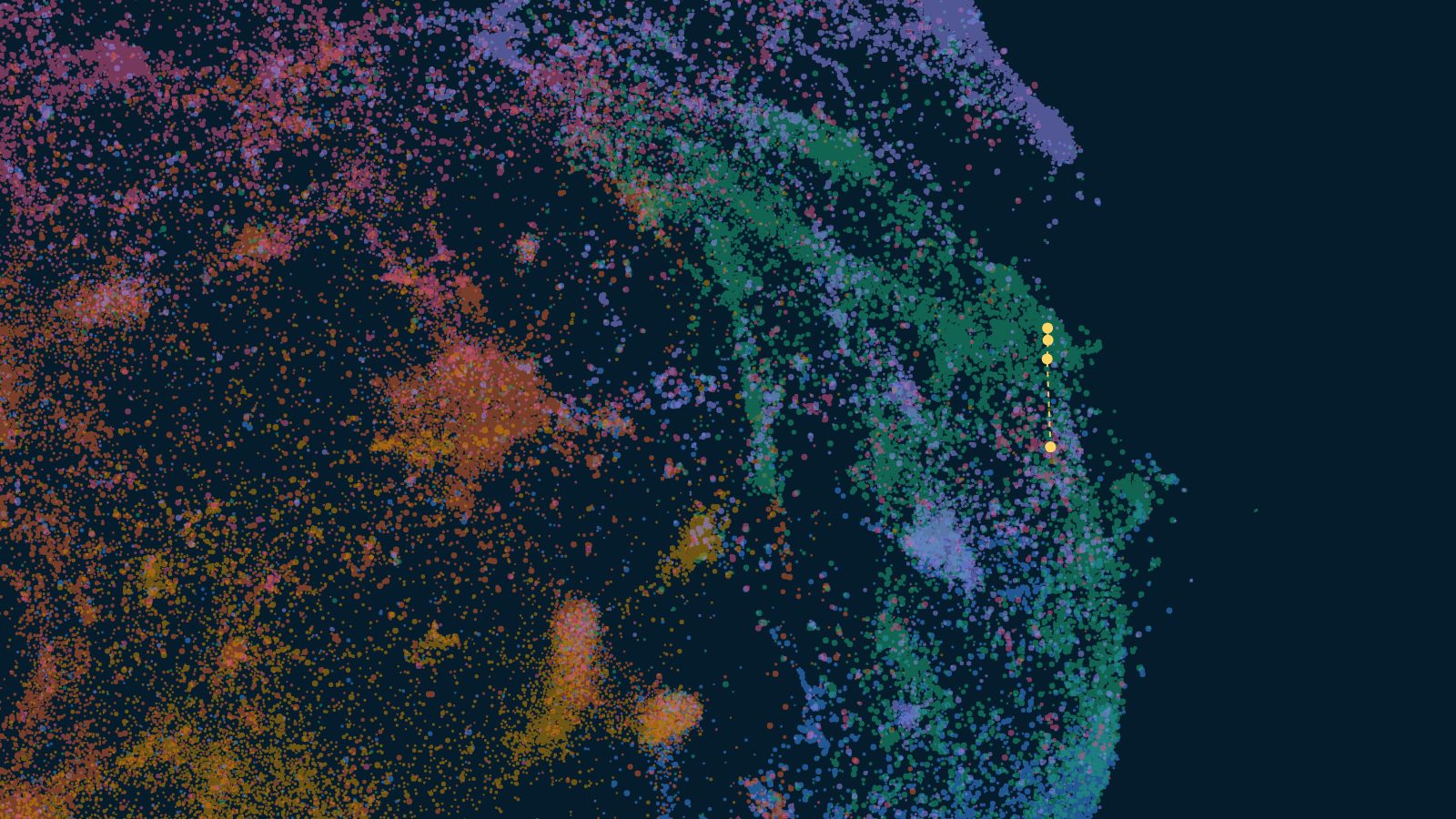
Cover: the Syntheos Map of Science, with thread 2 marked in gold.
This briefing used only public data. Yours would start from the decision in front of you and go as deep as it needs.